what is a system used to determine which different groups evolved based phonological relationships.
Classification systems are used to help us organize and study living things.
Then God said, "Permit the earth bring forth grass, the herb that yields seed, and the fruit tree that yields fruit according to its kind, whose seed is in itself, on the globe"; and it was and then. And the globe brought forth grass, the herb that yields seed according to its kind, and the tree that yields fruit, whose seed is in itself according to its kind. And God saw that it was good.—Genesis 1:11–12
What You Volition Learn
In that location are many different ways to group living things depending on the presuppositions that you start with.
Classification systems are used to assistance united states organize and report living things. At that place are many unlike ways to group living things depending on the presuppositions that you start with. Evolutionists believe that all living things descended from a single common ancestor. Considering they have this presupposition, they use the differences in physical traits, DNA, and protein sequences to determine relationships amidst different kinds of animals and plants. This assumption of a common ancestor has forced evolutionists to reorganize many of the original classifications of animals. Dinosaurs are now believed to be the ancestors of birds. Some accept even suggested reclassifying birds every bit reptiles since the molecular evidence is interpreted to support this merits. The classification of the apes, among which evolutionists include humans, has inverse to reflect the evolutionary view that humans are just intelligent apes. Some have even gone so far as to suggest that chimpanzees exist included in the human genus Human.
The Bible tells united states of america that man was created in the epitome of God, and therefore homo should not be classified as an ape. Creationists, starting from the truth found in the Bible, allocate living things into distinct "kinds" and recognize the amazing genetic variety found inside each kind. The field of baraminology involves studying the classification of living things through the biblical concept of the created kinds. The molecular evidence of proteins and Deoxyribonucleic acid can exist used to understand relationships inside the created kinds, simply it can't be used to sympathize how one kind changed into another, because that type of change has never occurred. Evolutionists will not arrive at an accurate understanding of the relationships of living things because their starting assumptions practice not reverberate the absolute truth available in God's Give-and-take.
What Your Textbook Says virtually Classifying Life
| Evolutionary Concept | Glencoe | PH-Campbell | PH-Miller | Holt | Articles |
|---|---|---|---|---|---|
| Linnaeus develops a system for classification. | 444 | 341 | 448–449 | 300 | ii:ane |
| Classification is based on evolutionary relationships and concrete traits. | 442 | T7, 341 | 452–453, 457 | T298 | 2:2 |
| Classification uses cladograms and phylogenetic trees to interpret and draw evolutionary relationships. | 445, 452 | 345–348, T345 | 453, 458, T458 | 310 | two:3, two:4 |
| Homologous and analogous structures are used to decide evolutionary relationships. | 444 | — | 384, T453 | 305, 594 | 3:half dozen, iii:7, iii:29 |
| Dinosaurs are the ancestors of modern birds. Birds are actually closely related to alligators. | 445, 452–453 | 345–348, T346, T558, T561, 564, 568 | 432, 799, 807, T807 | 307– 309, 727, T787 | ii:v, 2:6, 2:7, 3:35 |
| All life on earth came from a single mutual ancestor. | 454–455 | — | 382, T382– T383, T385, 410, T418, 457, 460–461 | 413 | 3:6, 3:7, iii:8, 3:thirteen, 3:19 |
| Evolutionary relationships can be determined by comparing Deoxyribonucleic acid and amino acrid sequences. Evolutionary time can be measured with molecular clocks. | 462 | T303, 341, 343, T343–T344 | 451, 454, T454, 455, T455 | 220, 232, 413, 602, 737 | 2:eight, three:half dozen, three:29 |
Annotation: Page numbers preceded by "T" indicate items from the teacher notes found in the margins of the Instructor's Edition.
What We Really Know most Classifying Life
Genesis records that God created the animals and plants according to their kind. Genesis explains that God created specific kinds of animals. These kinds were able to breed and reproduce more of the aforementioned kind with a great variety of traits. Information technology is not absolutely articulate what the boundaries of the original kinds were, but it is clear from Genesis that the different animals and plants did not evolve from one another. The creation of life on globe was certainly a miraculous event that man will never be able to fully understand—it must be accepted by religion. However, it requires but as much—if not more— faith to have the evolutionary story of the beginning of life and the first jail cell from lifeless thing.
The current arrangement of classification is based on the pioneering piece of work of the creation scientist Carolus Linnaeus. Linnaeus adult a classification system that was based on concrete characteristics. Linnaeus is credited with popularizing the utilize of hierarchies and binomial classification—the two-name arrangement used for names in science today. Linnaeus called man Homo diurnis (homo of the day) and grouped him in the primate grouping based on physical traits. Today, humans are called Man sapiens (wise human). Classifying humans based on physical traits lone does not reflect the biblical thought of being created in the image of God. While it is true that humans share the physical traits attributed to mammals, humans accept a spirit that distinguishes them from animals. Despite the fact that we share many traits with the primates, humans are not just highly evolved apes; nosotros were particularly created in the image of God.
Linnaeus based his piece of work on natural theology, the idea that God had created gild in the universe and man could understand that Divine Order by studying the creation. He wrote in a preface to Systema Naturae, "The Earth's cosmos is the glory of God, as seen from the works of Nature past Homo alone." Linnaeus believed in "fixity of species" (the thought that organisms do not change over time) early in his life, just his constitute-breeding experiments showed that hybrids were show against the idea that species have remained the same since they were created. Linnaeus constitute that hybridization could happen higher up the species level and that organisms in nature were in a state of competition. He explained this as the struggle for nature to maintain the balance that God had instilled in information technology at cosmos. New organisms that arose were all derived from the primae speciei (original kinds) and were a function of God'due south original program because He placed the potential for variation in the original creation. Modern biblical creationists still use the concept
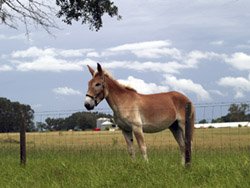
Creationists recognize sure created kinds that have been nowadays since they were created. Creationists and evolutionists agree that all of the varieties of dogs on earth have a common ancestor—when that antecedent existed is different in the two explanations. This mule is produced by breeding a horse with a donkey—evidence that horses and donkeys are of the same created kind.
Mod biblical creationists still utilise the concept of the created kind equally a footing for classification and the limit of variation. A group of creation scientists called the Biology Study Group is currently attempting to classify animals within created kinds, or baramins (from the Hebrew bara—create and min—kind), based on several criteria, including genetic information and convenance studies. The created kinds roughly stand for to the current classification at the family level. However, some kinds may extend up to the gild or down to the genus level, since the electric current organization of classification does not have the idea of special creation into account. Any organisms that tin interbreed are considered part of the same kind, merely those that tin't may or may non be. Further research is needed to understand which organisms, both living and extinct, vest to each created kind.
Created Kind (Baramin): the original organisms (and their descendants) created supernaturally by God as described in Genesis 1; these organisms reproduce only their ain kind within the limits of preprogrammed information, just with great variation.
Annotation: Since the original creation, organisms of i kind presumably cannot interbreed with a different kind, but individuals within a kind may have lost the ability (information) to interbreed due to the effects of the Curse.
Classification systems today are still based on physical characteristics, only the natural guild is no longer accepted equally coming from God. Bear witness of design in the natural world is ignored. Secular scientists repeat the mantra that the apparent design is just an accident and that matter and energy are all that can be used to describe how the universe works. Evolutionary relationships are used to reorganize moden classification systems based on the conventionalities that all organisms have a common ancestor.
Phylogeny is the report of the evolutionary relationships betwixt all living organisms. Taxonomists, scientists who classify living things, apply dissimilar types of diagrams to display the supposed relationships. These diagrams show how organisms are supposed to have descended from a single ancestor. The diagrams come in several forms. The fan diagrams testify the organisms with respect to their common ancestors and the relative size of the groups. Phylogenetic trees and cladograms are very similar in that they prove evolutionary relationships based on various characteristics. There is much debate in taxonomy about what traits to include when doing the analysis. Different relationships come to light depending on which characteristics are given the nearly weight in the system of classification. Evolutionists assume that they can construct the complete "tree of life" by including as many traits as possible. Evidence from DNA, anatomy, development, and fossils are commonly used in the structure of these systems.
A major problem with phylogenetic trees and other related models is the lack of bear witness that supports the links between known organisms and their supposed fossil relatives. The lines that connect an antecedent to the living organism are generally imaginary. Very picayune fossil testify supports the lines on the diagrams that connect the different kinds of organisms over millions of years, but the lines are often presented as fact. Darwin expected the fossils to evidence a progression of course, from fish to amphibian, for example, simply that progression is missing. The term "missing link" is often used to refer to these gaps and the missing fossils that supposedly fill them. Whenever you see i of these copse, ask, "What directly testify supports the lines on the tree?" In some cases at that place are examples of fossils that fit in the sequence, just the vast bulk are missing the prove. The reliability of such a model is called into question when information technology is based on and then many assumptions. The fossil record is discussed in more detail in Affiliate 4.
Creationists disagree with the idea of a "tree of life" as evolutionists see it—all life originating from a single, unknown, mutual ancestor. If nosotros consider the created kinds from Genesis, the picture of life would wait more like an orchard—distinct groups of animals showing variety within a kind. The trees in this orchard exercise non overlap one some other or cross one another, representing the limits of variety inside the Deoxyribonucleic acid of the created kinds. This view (developed by Dr. Kurt Wise) is confirmed by the show from operational science.

Analogy used with permission from Dr. Kurt Wise and Creation Science Fellowship of Pittsburgh from the 1990 ICC Proceedings, Bob Walsh editor, vol. 2, p. 358.
While new species have been observed to arise, it is always within the limits of the created kinds. The study of this variability and the relationships of animals within the original created kinds is called baraminology. This approach to classifying life is fundamentally opposed to the tree of life. This does not hateful that creationists reject the majority of classifications past evolutionary biologists but that the evolutionary history associated with the classifications is rejected. More research is needed in the field of baraminology to empathize the relationships inside the created kinds. This field of research can brand specific predictions about the relationships of organisms based on convenance experiments and ameliorate the current understanding of God'due south divine social club.
Evolutionists use the idea of "molecular clocks" to determine the corporeality of time that has elapsed since an alleged antecedent split into two groups. This evidence is used to advise that humans and chimpanzees came from a common ancestor that lived old between iv and 8 meg years ago. The operational science behind molecular clocks is based on differences in the DNA sequence or the sequence of amino acids in proteins. The tricky part is interpreting the time involved in these supposed changes. The model of molecular clocks assumes that development has happened. Yet, the thought of a Designer who used similar plans to create similar organisms and molecules is merely as reasonable an explanation from a scientific perspective.
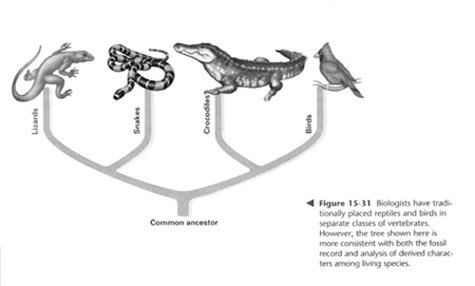
(PH-Campbell 347) The belief that all of these animals share a mutual antecedent is based on the supposition that development can create new information. The utilise of Dna and fossils to construct classification schemes has misled people to accept the idea that birds are actually closely related to crocodiles. The Bible describes these two as being created on separate days—not close relatives.
Another popular belief is that birds are really living dinosaurs. Some prominent scientists pass up to take the idea, simply many even so notice the mystique of watching a dinosaur eating from a feeder in the lawn intriguing. This idea is prominent in the textbooks and media, even though no theory seems to fit the scenario accurately. Whether or not a mechanism for evolving birds from some pocket-size theropod dinosaur tin be devised, many scientists are certain that it must have happened. It seems that most all of the new dinosaur fossils are shown past artists to have feathers. Even though there was no articulate evidence to back up the feathered interpretation, the feathers are added to convince the public that scientific discipline has found these things to be true. The next fourth dimension you hear of one of these feathered fossils, enquire to see the feather imprints—like the ones preserved and so well in the fossilized bird Archaeopteryx.
Ultimately, all classification schemes and theoretical relationships are based on man'due south interpretation of the evidence. Starting with the truth found in God's Discussion will lead united states of america closer to the true interpretation of the prove than starting with the fallible ideas of men.
Reference Articles
2:1 Carolus Linnaeus, Morris, Men of Scientific discipline, Men of God
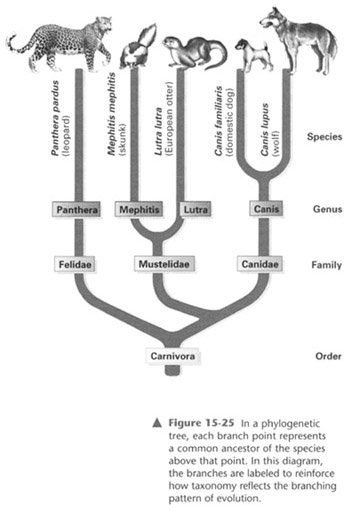
(PH-Campbell 343) Rather than a tree of life that began with a unmarried common antecedent, creationists believe life started with a certain number of created kinds. All life on earth is a issue of the genetic diversity in the originally created kinds. As a result, the creationist movie of life would await more like an orchard with many trees, each representing a created kind.
The modern system of classification is known as the Linnaean system and is based on the work of the creation scientist Carolus Linnaeus. Linnaeus was really trying to place the original kinds from Genesis in his research. Linnaeus related the Genesis kind to his category of species and therefore believed in the "fixity of species." Linnaeus recognized that variation happens within the created kinds, not between kinds. Evolutionists often brand the false claim that creationists believed, and still believe, that species don't alter.
two:2 Arthur Jones on biology, Ashton, Arthur Jones, Biology
Evolutionists often claim that the acceptance of creation is a "science stopper" and that the actions of God cut off the possibility for studying scientific concepts. This idea, however, is imitation. A belief in special creation only removes the option of continuous evolution, not the written report of the many other relationships amid living things. The study of cichlid fish by Dr. Jones showed the amazing variety of characteristics within the cichlid species, including coloration and power to survive in saltwater. What was also apparent was that the cichlids were a distinct kind of fish that showed no evolutionary relationships in the convenance experiments. The fossil tape supports the notion of fixed kinds of fish, with very few supposed transitional forms between kinds of fish. Creationists are not jump to any classification system that rises above the level of kind. Parts of the nomenclature schemes may be right equally they appear today, only more research needs to be done to analyze the relationships.
2:3 How to read an evolutionary family unit tree, Weston, www.answersingenesis.org/creation/v18/i3/familytree.asp
Charts and diagrams can be wonderful aids in giving clarity and visual reinforcement to a point or lesson 1 is trying to make. Yet, these explanatory tools tin can also be confusing, and in some cases misleading, when the illustrations and their implications are not fully explained. Such is the case with charts that supposedly prove the evolutionary relationship of creatures. A typical analogy, such equally the one showing insect ancestry, will try to convince you of how a certain group of creatures has evolved from a mutual ancestor in the by. Nevertheless, these charts almost e'er use dotted lines when the supposed evolutionary path is unknown. In these instances, you lot should but ignore the dotted lines. Past doing so, you volition normally be left with a diagram showing that the different types of species depicted have remained basically the same throughout history. Without the dotted lines, these charts simply show the diversity inside a kind, revealing that today'southward creatures haven't actually changed from so-called "ancient" ancestors. The dotted lines reinforce the fact that there is no evidence to prove the existence of a common ancestor. Go to your local library and check all the evolutionary trees you lot can find. You'll notice this a revealing and worthwhile exercise.

(Glencoe 435) When constructing the evolutionary history of life, scientists must make many assumptions. This diagram points out some of those assumptions. The lines represent inferences that many scientists disagree with. The dashed lines represent the "best estimate" at the relationships or places where the evidence is contradictory. At that place are no articulate links between the fossils shown when the dashed lines are removed.
2:4 Dinosaurs: phylogenetic chart, www.answersingenesis.org/get/phylogenetic-chart
The adjacent time yous see a phylogenetic tree ("tree of life") in a textbook or magazine article, take a look at the fine print. Honest diagrams will make a stardom betwixt the actual evidence and the interpreted data by using shading or dashed and solid lines. In the picture shown on the next page, the lighter lines indicate solid fossil bear witness and the darker lines and branching points stand for interpretations. So, the existent evidence shows stasis, non alter. Dinosaurs were dinosaurs and did not modify into something else or from something else. The links between kinds are simply stories virtually the evidence. The evidence does not testify development, equally is often suggested.
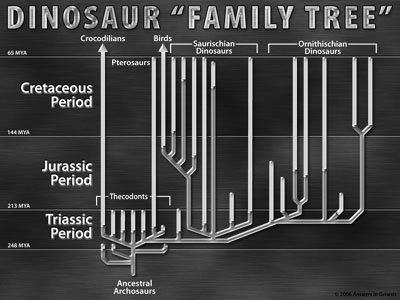
The lighter lines represent actual fossil evidence. The darker lines represent assumptions nigh relationships. When the assumptions are removed, the bear witness fits the creationist orchard model much better.
2:5 Archaeoraptor: featured dinosaur from National Geographic doesn't fly, Austin, world wide web.icr.org/article/464
A fossil discovered in 1999 was ane of many claimed by a number of scientists and promoted by the media, specially National Geographic, to be a feathered dinosaur. The fossil was from a region in China that has been producing many new fossil forms and changing many ideas surrounding the evolutionary history of secular scientists. The fossil was named Archaeoraptor and included a bird'due south upper body structure with fossilized feather imprints but the tail of a theropod dinosaur. The fossil was promoted as proof positive that birds had evolved from dinosaurs. The National Geographic article that accompanied the release of the fossil had a model of T. rex covered in feathers. This prompted the curator of birds at the Smithsonian Plant to proclaim:
With the publication of "Feathers for T. male monarch?" by Christopher P. Sloan in its November issue, National Geographic has reached an all-fourth dimension low for engaging in sensationalistic, unsubstantiated tabloid journalism.Upon farther test past various experts, it was adamant that the fossil was actually a fraud. The apparent difference in the body and tail were actually different— from two unlike organisms. Despite the fact that this and other "feathered dinosaurs" have been shown to exist fakes or misinterpretations, the media and many scientists are still claiming feathers should be shown on fossils that show no evidence of feathers.
two:6 On the declared dinosaurian beginnings of birds, Army camp, www.trueorigin.org/birdevo.asp
The idea of dinosaurs evolving into birds has been effectually since 1868 when it was first proposed by Thomas Huxley. Since Huxley, the hypothesis has undergone major shifts. Even after 130 years of new evidence, the interpretation is all the same contested. The presence of two new fossil species, Protarchaeopteryx and Caudipteryx, has shed little light on the topic. Depending on the bias of the interpreter, these 2 are either flightless birds or feathered theropod dinosaurs. The presence of short, gristly structures on a Sinosauropteryx fossil is often interpreted as "protofeathers" despite the fact that the existence and structure of these ancestral feathers are completely hypothetical.
In another problematic find, the fossil Protoavis is considered to exist more like to modern birds than Archaeopteryx but is 75 meg years older. This causes meaning bug for the theropod theory because the mutual ancestor would need to be much older than the earliest known dinosaur Eoraptor. The plastic nature of the evolutionary theory makes it certain that something else volition be put in the role of bird ancestor if the dinosaurs don't fit.
The development of the bird lung is another major event because no suitable antecedent exists from which the lungs could have adult. Some other major question is whether birds evolved from the ground upwardly (cursorial) or down from the trees (arboreal). Many hypotheses take been suggested, but in that location seems to be no solid show for one side or the other. The evolution of birds is an expanse where scientists accept found little to hold on. The special creation of birds and their subsequent variation explain the evidence much meliorate.
2:seven Scientific American admits creationists striking a sore spot, Matthews, world wide web.answersingenesis.org/become/sciam-sore
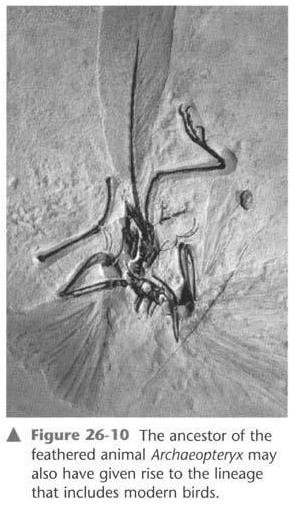
(PH-Campbell 567) Although no feathered dinosaurs take ever been found, many evolutionists believe that birds are living members of a line that began with a dinosaurian ancestor. Archaeopteryx is but an extinct perching bird, not a missing link in the evolution story. Birds and dinosaurs first appear fully formed in the fossil record with no evidence that one evolved into another.
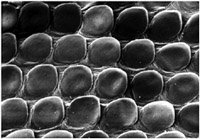
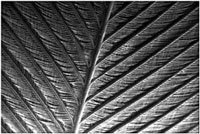
The many differences in the development of feathers and scales makes it articulate that scales could non have been remodeled to form a plume. Feathers and hair are much more closely related in development.
The old image of bird evolution is admittedly flawed, according to writers of an commodity in Scientific American. The authors admit that development does not provide a valid machinery for creating the amazingly strong, yet lightweight, structures plant in birds but not in their close dinosaur cousins. Archaeopteryx is discounted as shedding no light on the bailiwick since its feathers wait just like modern feathers. At that place is no fossil prove of the transition from simple reptilian scales to complex feathers with their many interlocking parts. Evolution cannot explain why feathers would have developed from scales for flight and and so developed a new developmental pathway to form them. To explain this, the authors propose that feathers evolved before theropod dinosaurs or birds. There is no fossil evidence to support this merits, and the possible reasons for the development of feathers includes camouflage, insulation, protection, and other hypotheses that are not supported by the fossil evidence.
Challenging development is not an option, so the evidence simply gets reevaluated. The new mode of interpretation is chosen evolutionary developmental biology, or "evo-devo" for short. According to evo-devo, "the complex mechanisms by which an individual organism grows to its total size and grade can provide a window into the evolution of a species' beefcake." In other words, by looking at the stages of plumage development in a bird today, we can await for "ancient" dinosaur feathers at the early stages of development. The new concept is based on many assumptions that limit its scientific validity, only information technology has become popular nonetheless. Challenges to the thought of dino-to-bird development continue to plague the proposal, and leading evolutionary biologists cannot even agree on the big motion-picture show, allow alone the details.
2:8 The demise of mitochondrial Eve, Harrub and Thompson, world wide web.trueorigin.org/mitochondrialeve01.asp
Evolutionary scientists believe that all humans on the earth originated from a pocket-size group in Africa over 200,000 years agone. This group included "mitochondrial Eve." Researchers of human being origins believe that the ancestry of humans can be traced by analyzing mutations of the DNA independent in the mitochondria of every cell. This mitochondrial Deoxyribonucleic acid (mtDNA) is assumed to be transferred only from mother to offspring in the egg cell. The mitochondria in the sperm do not enter the egg, so they don't become a office of the offspring's cells.
Assuming that the mtDNA sequence of two females should be more similar the farther back in time y'all go, researchers calculated how long ago the different people groups separated from each other. The African group had more differences from the other groups, so it is causeless that they accept had more than time to accumulate the mutations. The date was besides calibrated by using the assumed divergence of chimps and humans to calculate the rate of mutation.
The mitochondrial Eve thought is only valid if humans receive mtDNA just from the mother and if the rate of mutation is constant and known. Since none of these assumptions are known, the dating method may be invalid. Since recent enquiry indicates that at that place is mixing of paternal and maternal mtDNA, no conclusion about the rate or origin is reliable—mitochondrial Eve appears to exist dead.
The idea that mutation rates are abiding and can be used equally a "molecular clock" has also been called into question. The dates arrived at by molecular assay are much older than the dates given when paleontologists interpret the fossil bear witness. Many studies take shown that there are different rates of mutation in different populations and in unlike sections of the mtDNA. This makes the dating very speculative.
Questions to Consider
- Do the relationships shown in the phylogenetic trees ever alter?
- Since using different characteristics gives dissimilar phylogenetic trees, how can you know which tree is right?
- Can whatsoever one classification scheme (phylogenetic tree) be called right or incorrect if information technology is just an interpretation of the same testify equally other nomenclature schemes?
- Why do many artists describe feathers on dinosaurs when in that location is no evidence of actual feathers found with the fossils?
- Do scientists agree on how dinosaurs turned into birds?
- Does the fact that a majority of scientists think that dinosaurs evolved into birds go far true? What nearly those scientists who express joy at this idea?
- Since unlike sections of mitochondrial DNA mutate at different rates, how do scientists decide which rate to use when determining evolutionary dates?
Tools for Digging Deeper
(see a complete list in the Introduction)
Bones of Contention by Marvin Lubenow
Cached Alive by Jack Cuozzo
Creation: Facts of Life past Gary Parker
Evolution: The Fossils Withal Say No! by Duane Gish
If Animals Could Talk by Werner Gitt
www.answersingenesis.org/become/dinosaurs
Master Books has graciously granted AiG permission to publish selected capacity of this book online. To purchase a copy please visit our online store.
stollercortiferet.blogspot.com
Source: https://answersingenesis.org/creation-science/baraminology/classifying-life/
0 Response to "what is a system used to determine which different groups evolved based phonological relationships."
Post a Comment